

The Secret Glowing Superpower of Extra Virgin Olive Oil
- Howard Frank
- Food & Beverage
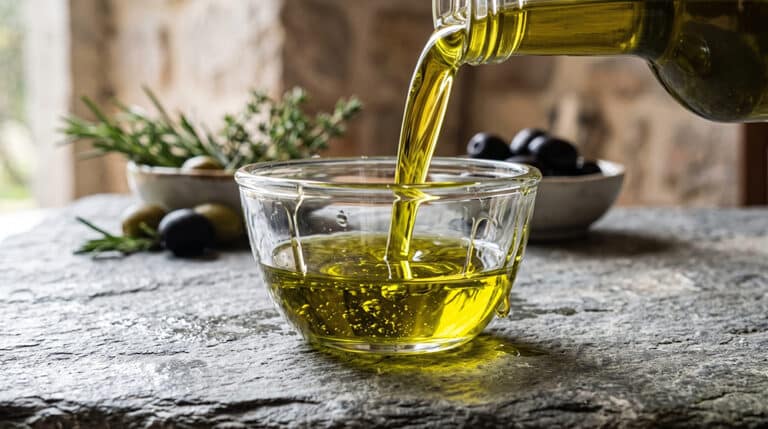
Ever drizzled a spoonful of rich, aromatic extra virgin olive oil over freshly toasted sourdough or a summer salad and thought, “This stuff tastes like magic”?
Well, as it turns out, you weren’t far off. Deep inside that golden-green elixir lies a microscopic superhero squad, and scientists have discovered they have a literal glow-in-the-dark fingerprint.
Grab your lab coats and salad tongs, because we’re diving into the delightful, light-emitting science of Extra Virgin Olive Oil (EVOO).
Meet the Microscopic Superhero Squad: Phenolic Compounds
Inside every drop of authentic EVOO, there’s a bustling metropolis of over 30 different phenolic compounds. Think of them as tiny cellular guardians, with fancy names like flavonoids, tannins, stilbenes, curcuminoids, and coumarins.
So, what is the researchers’ day job? Fighting the Cell Villains.
The Bad Guys: Free Radicals
Free radicals are hyper-reactive molecules floating around looking for trouble. Left unchecked, they attach to normal, healthy cells and cause oxidative chaos, contributing to cellular damage, heart disease, and cancers.
The Good Guys: Radical Scavengers & Antioxidants
EVOO’s phenolic compounds swoop in as radical scavengers. They neutralize free radicals before they can cause harm, calm down inflammation, regulate carcinogen metabolism, and even convince damaged cells to peacefully self-destruct (a process called apoptosis).
This is a big reason why the traditional Mediterranean diet is so celebrated for heart and cellular health.
EVOO vs. Regular Oil: The Tale of Two Extraction Methods
Not all olive oils wear the superhero cape. Here’s how the lineup breaks down:
| Oil Type | How It’s Made | Phenol & Nutrient Status |
|---|---|---|
| Extra-Virgin Olive Oil (EVOO) | Naturally pressed directly from the olive fruit without heat or harsh chemicals. | Loaded! Retains all 30+ natural antioxidants, vitamins, and anti-inflammatory compounds. |
| Refined / Regular Olive Oil | Processed, heat-treated, and chemically stripped. | Depleted. Stripped of its delicate phenolic superheroes and flavor nuance. |
Shining a Light on the “Fluorescent Fingerprint”
Here’s where things get wonderfully sci-fi.
A brilliant team of international science detectives, led by Dr. Ewa Sikorska from the Poznań University of Economics and Business in Poland, alongside Prof. Francesco Caponio and Prof. Antonella Pasqualone (University of Bari, Italy) and Prof. Igor Khmelinskii (University of Algarve, Portugal), decided to look at olive oil in a whole new light. Literally.
It turns out fresh EVOO has its very own fluorescent fingerprint. When exposed to specific wavelengths of light:
- Phenols, tocopherols, and chlorophylls emit a bright, distinct fluorescent glow.
- As the oil ages or deteriorates, that glow shifts and changes.
- If sneaky suppliers try to mix pure EVOO with cheap, deodorized refined oils, the glowing fingerprint instantly gives them away.
[ Fresh EVOO ] ───> Shines with Phenols, Tocopherols & Chlorophylls
[ Aged / Fake ] ───> Shifted Glow from Oxidation & Processing
Green Science with High-Tech Light Shows
Traditionally, checking an oil’s Total Phenolic Content (TPC) required “wet chemistry,” a slow, messy process involving chemical reagents and lab waste.
Dr. Sikorska wanted a faster, cleaner, “green” analytical procedure. By using advanced tools like the HORIBA Fluorolog® 3-11 and the supercharged HORIBA Aqualog®, now called the Aqualog®-Next. These instruments read excitation-emission matrices up to 100 times faster than conventional spectrofluorometers; the team can shine light right through opaque oil samples.
By pairing these Excitation-Emission Matrices (EEMs) with smart mathematical models (chemometrics), scientists can instantly read an oil’s health grade, freshness, and purity without adding a single chemical drop.
The Final Drizzle
So the next time you enjoy a pool of green EVOO paired with warm bread, remember: you aren’t just enjoying a tasty Mediterranean staple. You are eating a vibrant, light-emitting, free-radical-fighting elixir of pure nature.
Enjoy the blog? Sign up for your monthly dose of whimsical spectroscopy insights.
Recommended for you


