The Grapevine Whisperers: A New Era in Smoke Taint Detection
- Howard Frank
- Food & Beverage
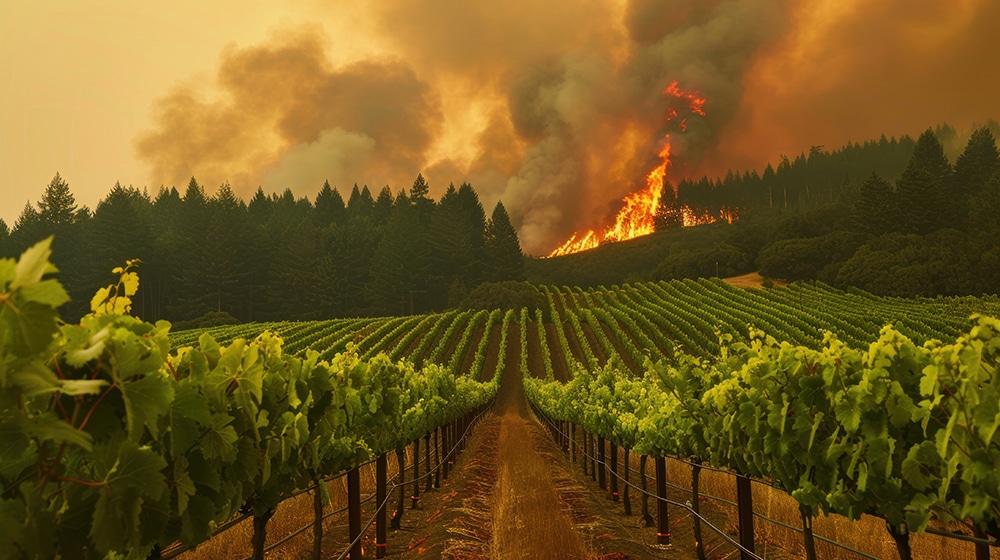
Ah, the world of winemaking, where grapevines bask under the golden sun, ripening to perfection, only to be threatened by the uninvited guest—wildfire smoke. Picture this: winemakers laboring under the scorching sun, tending to their beloved vines, only to have their hopes clouded by the hazy aftermath of a wildfire. This isn’t just a tale of scorched earth and charred wood; it’s the story of smoke taint, an insidious beast that lurks within the very grapes destined to become your next favorite bottle of wine.
The Invisible Menace: Smoke Taint
Smoke taint sounds like something out of a winemaker’s worst nightmare. When wildfire smoke lingers over vineyards, it can seep into the grapevines, embedding smoky, burnt, and ashy flavors that no one wants in their glass of Pinot Noir. As if battling the elements wasn’t enough, winemakers now face the daunting task of identifying and mitigating smoke taint in their grapes.
The Quest for a Solution
Enter the dynamic duo: Kerry Wilkinson, Ph.D., and her intrepid Ph.D. student, Colleen Szeto. Their mission? To find a way to detect smoke taint in grapes and wine more efficiently, using a method that is simpler, faster, and less expensive. The hero of their story? A-TEEM spectroscopy.
Kerry Wilkinson, a Professor of Oenology at The University of Adelaide, has dedicated her research to understanding the complexities of smoke taint. She explains that smoke-exposed grapes absorb volatile phenols, which the grapevines then bind with sugar molecules, forming glycoconjugates. This biochemical transformation complicates detection, as two different forms of the compounds must be analyzed.
A-TEEM to the Rescue
Traditional methods for detecting these compounds involve complex and expensive procedures like gas chromatography-mass spectrometry (GC-MS) and liquid chromatography-mass spectrometry (LC-MS). These are not only costly but also time-consuming, which is a significant drawback when the harvest season is in full swing.
Wilkinson and Szeto, however, are pioneering a new approach using HORIBA’s Aqualog, a device that leverages A-TEEM spectroscopy. This cutting-edge technology allows for rapid, precise, and accurate measurement of absorbance and transmission spectra alongside fluorescence Excitation-Emission Matrices (A-TEEM). In layman’s terms, it can quickly and efficiently identify smoke taint markers in grapes and wine with minimal sample preparation.
Changing the Game
The beauty of A-TEEM spectroscopy lies in its speed and cost-effectiveness. The Aqualog can scan a wide range of wavelengths in just minutes, providing winemakers with the data they need to make informed decisions about their harvest. This quick turnaround is crucial during the tight schedules of the grape harvest season.
Wilkinson envisions a future where this technology allows for pre-screening grapes right in the vineyard. Imagine being able to determine on the spot whether your grapes are safe from smoke taint or if they need further analysis. This could save winemakers time, money, and heartache.
A Brighter Future for Winemakers
With the increasing frequency and duration of wildfires, the importance of such innovations cannot be overstated. The research by Wilkinson and Szeto offers hope and practical solutions to an industry grappling with the effects of climate change. Their work not only aids in producing better wine but also supports the livelihoods of those dedicated to the craft of winemaking.
In conclusion, the advancement in smoke taint detection spearheaded by Wilkinson and Szeto is a beacon of hope for winemakers worldwide. Through the use of A-TEEM spectroscopy, they are turning the tide against the invisible menace, ensuring that our glasses remain filled with the purest of wines. Cheers to that.
Enjoy the blog? Sign up for your monthly dose of whimsical spectroscopy insights.
Recommended for you